I love a good coaching tool: a template, a checklist, a protocol, an app, a pile of sticky notes or anything else that supports my work as an instructional coach.

For a while, I’ve resisted ChatGPT, but realized I could be ignoring a new potential coaching tool and why would I do that?!

So, I began experimenting with ChatGPT and how it might support my coaching.

And you know what? 

It can.

Here are ten prompts I’ve tentatively explored using ChatGPT in my own coaching practices and maybe, they’ll support yours, too:
What happens when you want to offer teachers a book study experience, but you do not have the time to meet or the money to purchase books for everyone? You start a book relay!
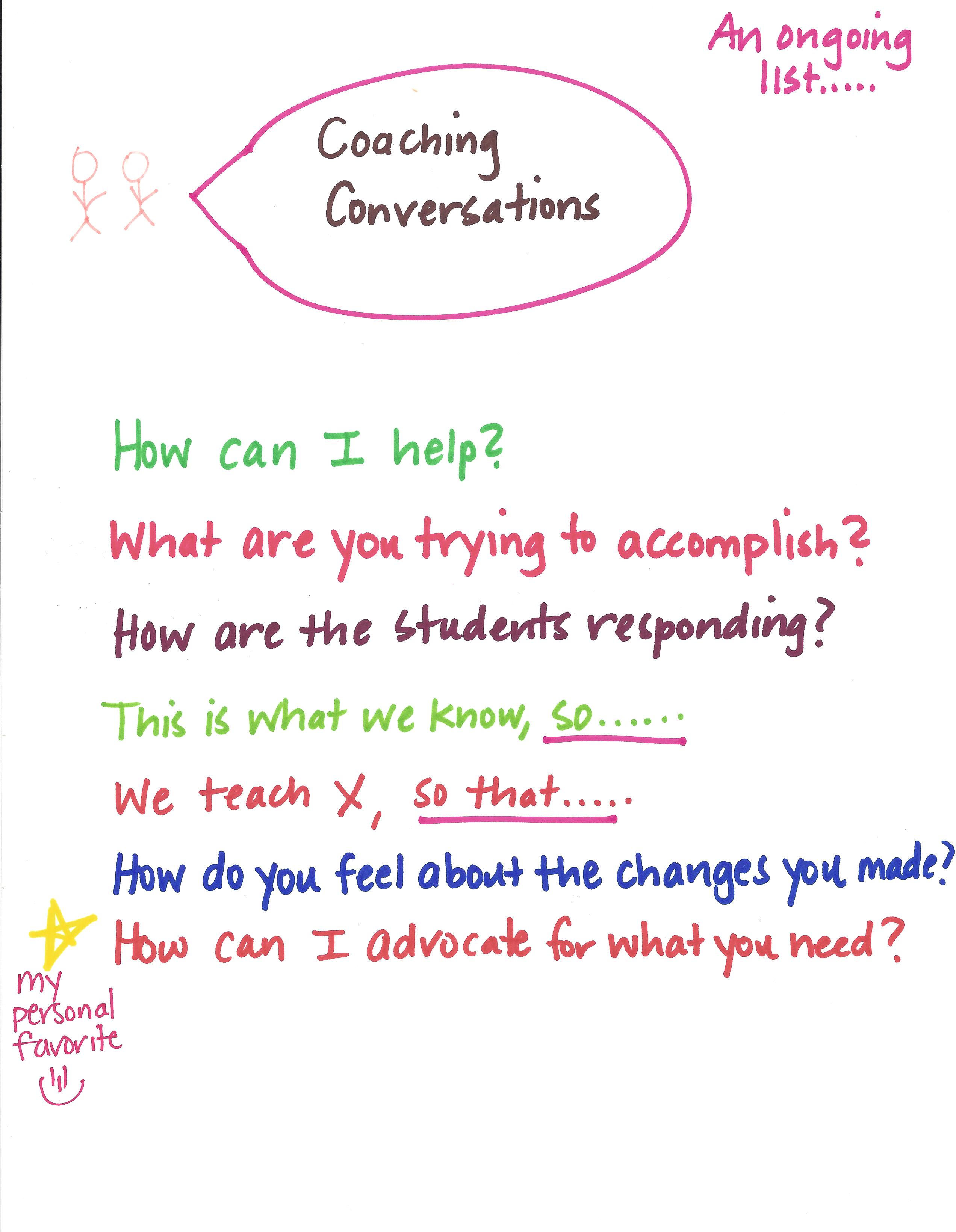
Let’s think for a moment about our coaching language. What are the phrases you find yourself using the most as part of your coaching cycles? Maybe you use some of these:
Who knew that such a simple metaphor could yield such rich conversations and actions around solving instructional challenges? 

I am a reader. A always-have-a-book-in-my-bag-please-help-me-find-time-to-read-it kind of reader. And I savor the words, collecting them in my journal for later reflection.

I have a small Moleskine notebook that accompanies me wherever I go, just as Peak Marcello did as he climbed Mount Everest in Roland Smith’s Peak.
I’ve always been fascinated by what coaches do and why they do it. In fact, I spent three years studying multiple literacy coaches in multiple districts as part of my dissertation.

And you know what I found out?

Literacy coaches do A LOT of things….but they sometimes don’t realize the reality of their coaching activities until they are spelled out in a tangible way, preferably on paper and with colorful markers. =)
I love the start of a brand new year because I absolutely, positively adore creating visions. There’s just something about sitting down and imagining the best version of my future self that fires me up and gets me going.

I create visions in a few ways: I draw pictures of the life I want to have, I create 6-word stories to act as a mantra for my work life, I write my ideal job description and even have fun creating the perfect day. I may have even been known to create a pinterest board or two around these visions.

There’s just one problem.

I’m not nearly as good at bringing these visions to life as I am at dreaming them up.

Until now.
A few years ago, I was asked to deliver a keynote address to a group of reading coaches working in local schools. I created a presentation that focused on reading motivation, choosing books for students, strategy teaching and the importance of teacher language. I even involved social media and live participation. I was quite pleased with how it turned out and was looking forward to my session.

That all changed when I arrived.
I am a pretty positive person. I try to look for the silver lining, but if I am honest, I am much better at finding the silver lining for someone else than I am for myself. Can you relate?
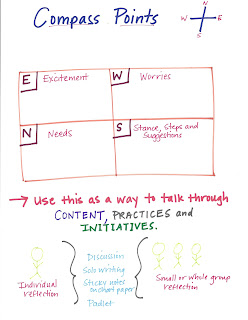
The School Reform Initiative is a powerful resource for coaching and leading and their Compass Points protocol is worth sharing. The original Compass Points activity helps teachers learn about their preferences for working with others and how our collective preferences can impact our learning communities. If you have not yet explored this idea, I highly recommend you do so. It is a great way to get to know a group of people and how that information can support your coaching.
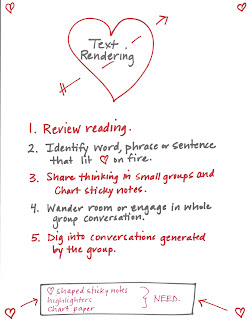
I know, I know. How could I possibly say ‘text rendering’ and ‘set hearts on fire’ in the same title? Because it’s possible. 

Text rendering is the process of deconstructing a text: selecting portions that are important and making meaningful connections with the content. 
I’ve been privileged to have thousands of conversations with hundreds of administrators on the topic of literacy coaching and instruction. One particular conversation springs to mind and brings a smile to my face, even many years later.

After a think tank session where we created a vision and plan for the year, an elementary principal looked at me and said: “You know…other people look at you and see a kind, helpful face, but I see you as a walking, talking color-coded chart who instantly makes sense of the jumble of information in my mind.”
Instructional coaches offer teachers feedback in multiple ways: observations, demonstration lessons, co-teaching, professional learning sessions and more. While I love all aspects of coaching, there is something powerful about observing classroom instruction with a lens on what is going well. And while many of us might be back to coaching in person, there’s something even more powerful in using video observation as part of an in-person or virtual coaching cycle.
Before we can coach in the classroom alongside teachers, we must first be invited into it and instructional coaches understand just how difficult this can sometimes be.
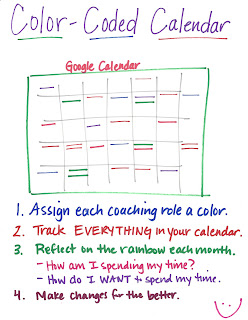
I love notebooks. I love planners. I love calendars in all shapes and sizes. And, since you are reading this post on a blog that celebrates notebooks, sticky notes and colorful markers, you likely already know this. =)

But, did you know exactly HOW I use all of those notebooks? I use one notebook to capture coaching sketchnotes and ideas to make my coaching more joyful and effective. In fact, this entire blog is a digitized version of that notebook! I use another notebook to plan and take notes on professional learning sessions and grade level meetings. I have another notebook dedicated only to coaching cycles so I can keep track of teachers’ individual goals and our coaching activities together, too.

But there’s one more notebook I haven’t shared with you yet. Actually, it’s a calendar. A coaching connection calendar. Let me explain.
This may be the easiest and most versatile idea I have tried to engage teachers in discussion, reflection and collaboration during professional learning sessions. This incredibly simple activity requires no preparation, can be used in virtually any professional learning session, can be personalized to whatever content you are hoping to explore and is sure to spark thinking and discussion. Really. 
If you have read any of my other posts, you know how much I love sticky notes: big ones, small ones, colorful ones, plain ones, shaped notes, tall notes, short notes, every single kind of sticky note. I use them in lots of ways, but today, I’d like to share how I use sticky notes to create shared norms with a new group of educators, perfect for the beginning of the school year. It’s hands-on, colorful and gets teachers thinking in a hands-on-minds-on way. 
I cannot quite believe it, but I have been teaching at my University for over 16 years. And for all of those years, I’ve been working with teachers virtually part of our online literacy programs. I love creating online professional learning experiences, but my biggest challenge as an online instructor (and literacy coach!) has been to create a community of learners that has the same spirited feel of in-person communication.

I’ve tried all sorts of ideas and activities to come together as a community, but this one is a game-changer and I now use it to build teacher learning communities online and in person: Interactive Introductions with Google Slides.
Did you know I have a coaching secret weapon? I do. It’s my Quick Win Toolkit. And now, you can have one, too.
I love whimsy and one of the ways I bring a bit of whimsical fun to instructional coaching is by creating and happily sharing PD party favors. Wait. What?! Yes, PD party favors. Let me explain.
© The Coaching Sketchnote Book with Dr. Stephanie Affinito · THEME BY WATDESIGNEXPRESS